
How to Read a Peptide Certificate of Analysis (COA)
Every APX Labs order ships with a batch-specific COA. This is how to read it — and how to tell a real one from a decorative one.
Published 2026-09-18 · APX Labs Research Desk · For laboratory research context only — not medical advice.
A real peptide COA names the lot, shows an HPLC chromatogram with a purity percentage derived from peak area, shows a mass-spectrometry result whose measured mass matches the theoretical molecular weight, and comes from a laboratory independent of the seller. If any of those four is missing, treat the number on it as marketing.
What a COA is — and is not
A Certificate of Analysis is a testing laboratory's report on one specific lot of material. It states what tests were run and what they found. It is not a certificate of quality for the product line, the seller, or any other lot — a COA for lot APX-118 says nothing about lot APX-119. That is why the first thing to check is the lot number.
For a research peptide, a complete COA answers two questions: *is this the molecule it claims to be* (identity) and *how much of the sample is that molecule* (purity). Everything else is supporting detail.
Step 1 — Match the lot number
The lot printed on the vial or pen must match the lot on the COA. If a seller shows a single COA for a product regardless of when it was made, it is not batch-specific and does not describe what you received. APX Labs prints the lot on the label and ships the matching COA in the box.
Step 2 — Read the HPLC purity
High-performance liquid chromatography separates the sample into peaks by how fast each component moves through a column. The chromatogram is the graph; the main peak is the target peptide; smaller peaks are impurities — typically deletion sequences, truncated chains, or oxidation products from synthesis [1].
Purity is the main peak's area as a percentage of total peak area. A COA should show the chromatogram (or at least the peak table) and the calculated percentage, not just a number. ≥99% is the standard for research-grade material and is what APX Labs specifies; 95–98% is common in lower grades. Read the HPLC/MS explainer for the method detail.
Step 3 — Read the mass-spectrometry identity
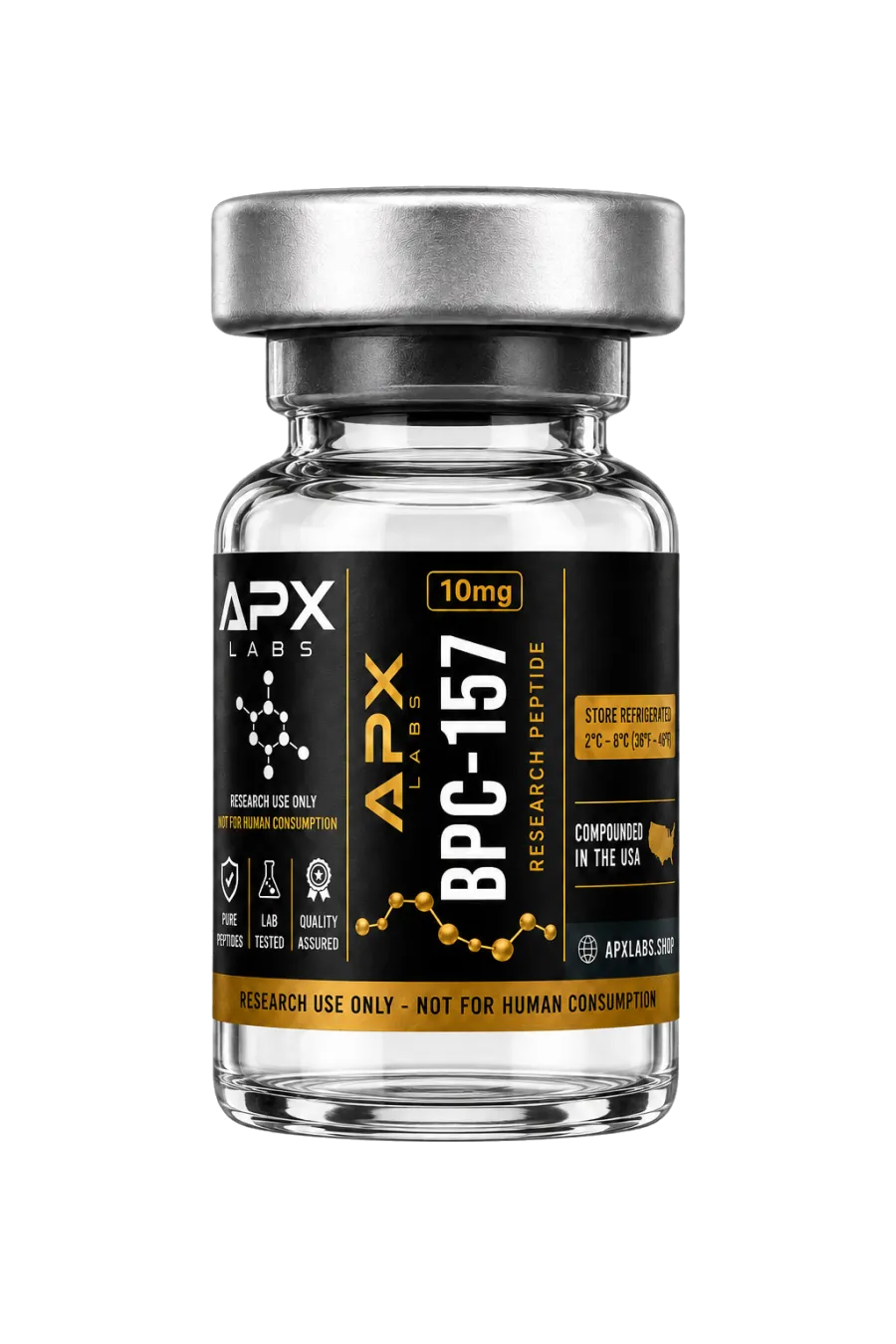
Purity alone can mislead: a sample can be 99% pure and be the wrong peptide. Mass spectrometry measures the molecular mass of the main component and compares it with the theoretical mass of the expected sequence. On the COA, look for the theoretical (calculated) MW next to the observed (found) MW — for BPC-157 that is 1419.5 g/mol. Agreement within instrument tolerance confirms identity. High-resolution MS can also characterise the impurities themselves [2].
Common variations: the observed value may be reported as [M+H]+ (one proton heavier) or as a multiply-charged ion; the COA usually notes this.
Step 4 — Check who ran the test
An independent, named laboratory with its own report format is the strongest signal. A COA generated on the seller's own letterhead with no lab identified is a weaker one. APX Labs uses an independent laboratory for every lot; the lab's report is what ships.
Step 5 — Look at the date and the method
The test date should be close to the lot's production date. The method section should name the technique (RP-HPLC with UV detection at a stated wavelength is typical for peptides) — a COA that says only 'HPLC' with no conditions is thin.
Red flags
- No lot number, or one that does not match your vial.
- A purity number with no chromatogram or peak table.
- No mass-spec result, or an observed mass that does not match the theoretical one.
- Round numbers (exactly 99.0%, 100%) across every product — real results vary lot to lot.
- No laboratory identified.
- The same COA image reused across a seller's product range.
What APX Labs' COA contains
Lot number matching the label; RP-HPLC chromatogram and purity percentage; MS observed vs theoretical mass; test date; the independent laboratory's identification. For blends, each component is reported. See the testing process for how lots move from synthesis to shipment.
A COA documents what a laboratory measured in a sample. It is not a statement about effects, safety, or suitability for any use. APX Labs products are for laboratory research only.
Frequently asked
What purity should a research peptide COA show?⌄
What is the difference between purity and identity on a COA?⌄
Is a COA the same for every lot?⌄
References
Published research cited for context only. Citing a study does not imply APX Labs product was used in it, and is not a claim of any effect.
- Badgujar D, Bawake S, Yuvaraaj VK et al. (2025). Assessment of Thermal and Photolytic Stress Effects on the Stability of Primary Structure of Synthetic Peptides. J Pept Sci. PubMed ↗
- Kodidasu A, Acharyya K, Ramu VG (2025). Absolute Quantitation of Coeluting Impurities in Peptide Drugs Using High Resolution Mass Spectrometry. J Am Soc Mass Spectrom. PubMed ↗
Compounds mentioned
Keep reading
- BPC-157 vs TB-500: What the Research Actually ComparesThe two most-requested recovery-category peptides are structurally unrelated and studied through different pathways. Here is the side-by-side, with sources.
- How to Reconstitute Lyophilized Peptides for Laboratory UseLyophilized peptides arrive as a dry cake in a sealed vial. Turning that into a solution of known concentration is simple, but the details protect the material.
- How to Store Research Peptides: Lyophilized, Reconstituted and Pre-FilledPeptides degrade by hydrolysis, oxidation and aggregation. Cold, dark and dry slow all three. The practical rules, by format.
Ready to start your research?
Third-party tested. COA-backed. Shipped discreetly. For research use only.