
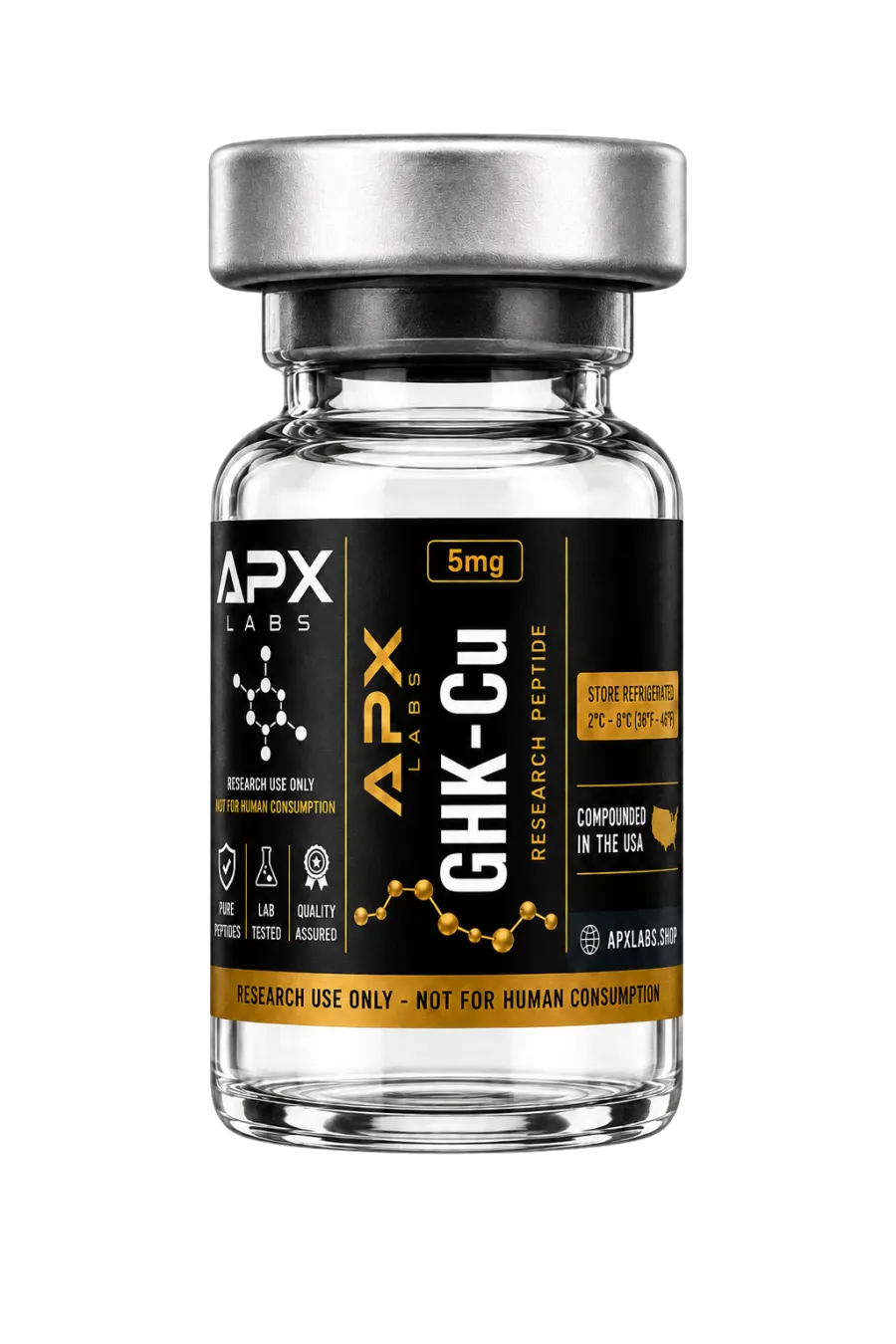
GHK-Cu
GHK-Cu is the copper(II) complex of the tripeptide glycyl-L-histidyl-L-lysine — 403.9 g/mol as the complex. GHK occurs naturally in human plasma, saliva and urine, and its concentration declines with age; the copper-bound form is the one studied since the 1970s for collagen synthesis, connective-tissue accumulation and, more recently, broad gene-expression modulation in skin and regeneration models. APX Labs supplies it as a 50 mg lyophilized vial, ≥99% purity by HPLC/MS, with a batch-specific COA. Research use only.
- Class: naturally occurring copper-binding tripeptide
- Sequence: Gly-His-Lys complexed with Cu(II) · 403.9 g/mol
- Research contexts in the literature: collagen and connective-tissue synthesis, skin-regeneration pathways, oxidative-stress models, gene-expression datasets
- Format: 50 mg lyophilized vial — reconstitute with bacteriostatic water (solution is characteristically blue)
- Documentation: independent HPLC/MS test, batch-specific COA in every order
- Research category
- Regeneration
- Amino-acid sequence
- Gly-His-Lys · Cu(II)
- Formula / short form
- Gly-His-Lys : Cu
- Molecular weight
- 403.9 g/mol
- Quantity per vial
- 50 mg
- Purity
- ≥99% (HPLC/MS, per-lot COA)
- Test method
- HPLC / MS
- Form
- Lyophilized powder
- Documentation
- Batch-specific COA ships with every order
What is GHK-Cu?
GHK was first isolated from human plasma in 1973 by Loren Pickart, who observed that it bound copper with high affinity. The tripeptide-copper complex — GHK-Cu — is among the most-studied small peptides in dermatology and regeneration research and is unusual in this catalog for being endogenous: the body makes it. Reconstituted GHK-Cu solution is a distinctive blue, a visual signature of the copper complex.
What is GHK-Cu studied for in research?
- Collagen and connective-tissue synthesis. Foundational fibroblast-culture work reported stimulation of collagen synthesis by the copper complex [1]; an in-vivo study reported connective-tissue accumulation [2].
- Skin regeneration pathways. Reviews collect GHK's studied role as a modulator of multiple cellular pathways in skin [3].
- Gene expression and ageing models. Later work matched GHK against large gene-expression datasets [4] and reviewed its studied role in oxidative-stress and degenerative models [5].
Cell, animal and dataset findings only — not claims of human effect.
Specifications, purity and documentation
Identity by mass spectrometry, purity by HPLC, batch-specific COA in every order. The COA reports the peptide; copper content is inherent to the complex as supplied. How to read the COA →
GHK-Cu — frequently asked
What is GHK-Cu?⌄
Why is reconstituted GHK-Cu blue?⌄
How is GHK-Cu different from KLOW?⌄
How should GHK-Cu be stored?⌄
Further reading
- How to Read a Peptide Certificate of Analysis (COA) — Every APX Labs order ships with a batch-specific COA. This is how to read it — and how to tell a real one from a decorative one.
- How to Reconstitute Lyophilized Peptides for Laboratory Use — Lyophilized peptides arrive as a dry cake in a sealed vial. Turning that into a solution of known concentration is simple, but the details protect the material.
- How to Store Research Peptides: Lyophilized, Reconstituted and Pre-Filled — Peptides degrade by hydrolysis, oxidation and aggregation. Cold, dark and dry slow all three. The practical rules, by format.
References
Published research cited for context only. Citing a study does not imply APX Labs product was used in it, and is not a claim of any effect.
- Maquart FX, et al. (1988). Stimulation of collagen synthesis in fibroblast cultures by the tripeptide-copper complex glycyl-L-histidyl-L-lysine-Cu2+. FEBS Lett. PubMed ↗
- Maquart FX, et al. (1993). In vivo stimulation of connective tissue accumulation by the tripeptide-copper complex glycyl-L-histidyl-L-lysine-Cu2+. J Clin Invest. PubMed ↗
- Pickart L, Margolina A (2015). GHK Peptide as a Natural Modulator of Multiple Cellular Pathways in Skin Regeneration. Biomed Res Int. PubMed ↗
- Pickart L, Margolina A (2018). Regenerative and Protective Actions of the GHK-Cu Peptide in the Light of the New Gene Data. Int J Mol Sci. PubMed ↗
- Pickart L, Vasquez-Soltero JM, Margolina A (2012). The human tripeptide GHK-Cu in prevention of oxidative stress and degenerative conditions of aging. Oxid Med Cell Longev. PubMed ↗
What is GHK-Cu studied for?
Widely referenced in regeneration research for its studied role in collagen synthesis, wound-repair signalling, and antioxidant activity.
Reconstitution & storage
Ships lyophilized in a sealed vial. Store cold and away from light. Reconstitute with bacteriostatic water (not included); once reconstituted, keep refrigerated and use within the window documented on the COA.
Research use only
Sold strictly for laboratory and research purposes. Not for human or veterinary use, and not intended to diagnose, treat, cure, or prevent any disease. Not evaluated by the FDA. Read the policy → · What RUO means →

Ready to start your research?
Third-party tested. COA-backed. Shipped discreetly. For research use only.