
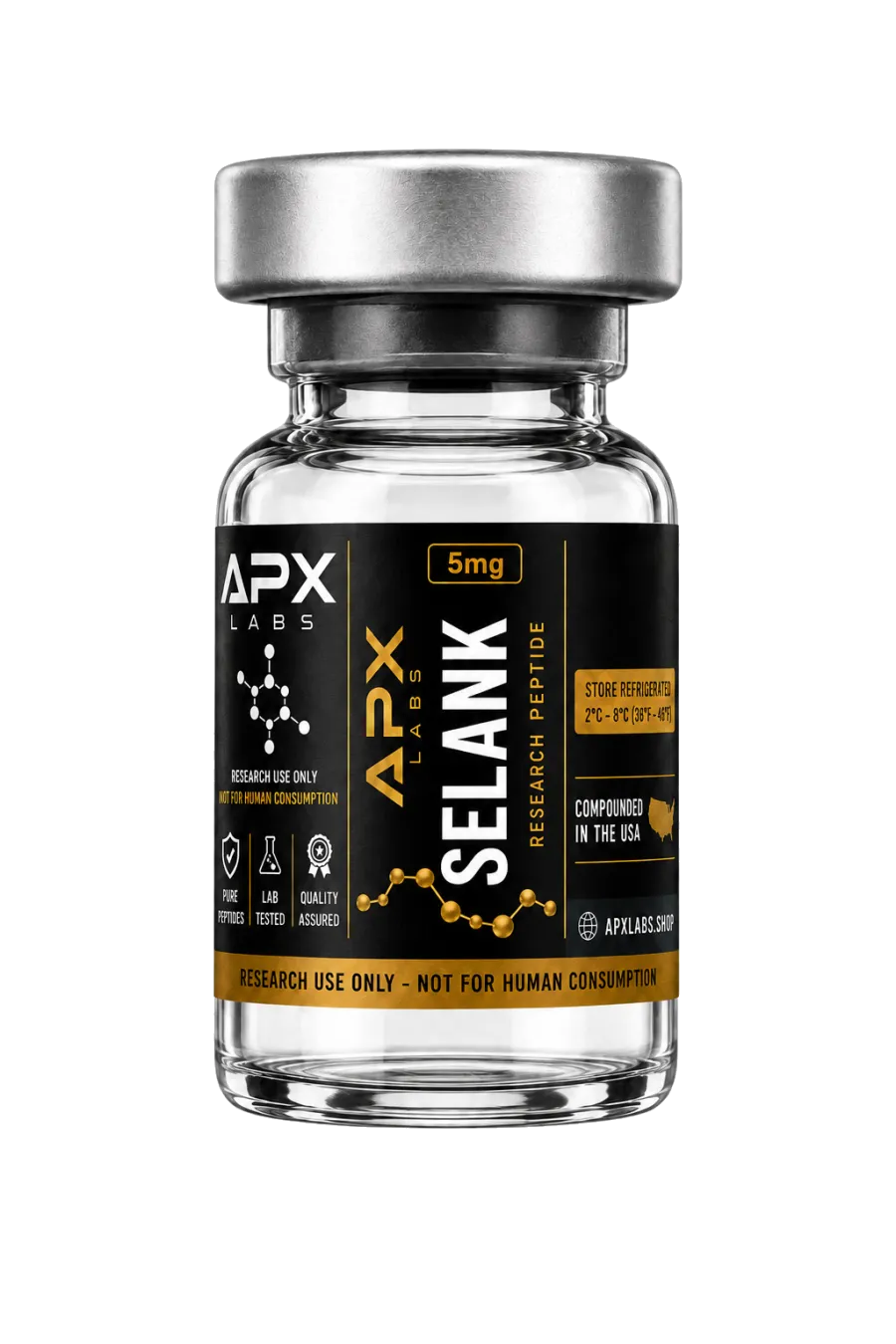
Selank
Selank is a synthetic heptapeptide — Thr-Lys-Pro-Arg-Pro-Gly-Pro, 751.9 g/mol — built from the immunomodulatory tetrapeptide tuftsin (Thr-Lys-Pro-Arg) with a Pro-Gly-Pro tail added for stability. Developed in Russia, it is studied in rodent models for anxiolytic-type behaviour, stress adaptation and GABA-system interaction. APX Labs supplies it as a 10 mg lyophilized vial, ≥99% purity by HPLC/MS, with a batch-specific COA. Research use only.
- Class: tuftsin analog with C-terminal Pro-Gly-Pro
- Sequence: Thr-Lys-Pro-Arg-Pro-Gly-Pro · 751.9 g/mol
- Research contexts in the literature: anxiolytic-type behaviour, adaptive behaviour under stress, withdrawal models
- Format: 10 mg lyophilized vial — reconstitute with bacteriostatic water
- Documentation: independent HPLC/MS test, batch-specific COA in every order
- Research category
- Cognition & Focus
- Amino-acid sequence
- Thr-Lys-Pro-Arg-Pro-Gly-Pro
- Formula / short form
- TKPRPGP
- Molecular weight
- 751.9 g/mol
- Quantity per vial
- 10 mg
- Purity
- ≥99% (HPLC/MS, per-lot COA)
- Test method
- HPLC / MS
- Form
- Lyophilized powder
- Documentation
- Batch-specific COA ships with every order
What is Selank?
Tuftsin is a naturally occurring tetrapeptide fragment of immunoglobulin G with immune-signalling activity. Selank extends it with Pro-Gly-Pro — the same stabilising tail used in Semax — producing a heptapeptide that has been studied since the 1990s by the Institute of Molecular Genetics in Moscow for behavioural rather than immune endpoints.
What is Selank studied for in research?
- Anxiolytic-type activity. A 2018 review in *Protein & Peptide Letters* collects the molecular work on Selank's studied anxiolytic activity [1].
- Adaptive behaviour under stress. Early work characterised Selank and related tuftsin-family peptides in stress-adaptation models [2].
- Withdrawal models. A 2014 rat study examined the compound in a modelled alcohol-withdrawal setting [3].
Rodent findings only — not claims of human effect.
Selank vs Semax
The two Russian-origin heptapeptides share a stabilising tail but nothing else: Selank derives from tuftsin and is studied for anxiolytic-type endpoints; Semax from ACTH(4-10) and is studied for neurotrophin expression. Full comparison: Semax vs Selank.
Specifications, purity and documentation
Identity by mass spectrometry (expected 751.9 g/mol), purity by HPLC, batch-specific COA in every order. How to read the COA →
Selank — frequently asked
What is Selank?⌄
How is Selank different from Semax?⌄
How should Selank be stored?⌄
Further reading
- How to Reconstitute Lyophilized Peptides for Laboratory Use — Lyophilized peptides arrive as a dry cake in a sealed vial. Turning that into a solution of known concentration is simple, but the details protect the material.
- Semax vs Selank: Two Russian Heptapeptides, Two Different Research Questions — They share a country of origin, a length and a stabilising tail — and almost nothing else. Here is how the research literature separates them.
References
Published research cited for context only. Citing a study does not imply APX Labs product was used in it, and is not a claim of any effect.
- Vyunova TV, et al. (2018). Peptide-based Anxiolytics: The Molecular Aspects of Heptapeptide Selank Biological Activity. Protein Pept Lett. PubMed ↗
- Kozlovskaya MM, Kozlovskii II, Val'dman EA (2003). Selank and short peptides of the tuftsin family in the regulation of adaptive behavior in stress. Neurosci Behav Physiol. PubMed ↗
- Kolik LG, Nadorova AV, Kozlovskaya MM (2014). Efficacy of peptide anxiolytic selank during modeling of withdrawal syndrome in rats with stable alcoholic motivation. Bull Exp Biol Med. PubMed ↗
What is Selank studied for?
Investigated in behavioural research models for its studied anxiolytic-type and cognition-related signalling.
Reconstitution & storage
Ships lyophilized in a sealed vial. Store cold and away from light. Reconstitute with bacteriostatic water (not included); once reconstituted, keep refrigerated and use within the window documented on the COA.
Research use only
Sold strictly for laboratory and research purposes. Not for human or veterinary use, and not intended to diagnose, treat, cure, or prevent any disease. Not evaluated by the FDA. Read the policy → · What RUO means →
Ready to start your research?
Third-party tested. COA-backed. Shipped discreetly. For research use only.