
Semax vs Selank: Two Russian Heptapeptides, Two Different Research Questions
They share a country of origin, a length and a stabilising tail — and almost nothing else. Here is how the research literature separates them.
Published 2026-09-18 · APX Labs Research Desk · For laboratory research context only — not medical advice.
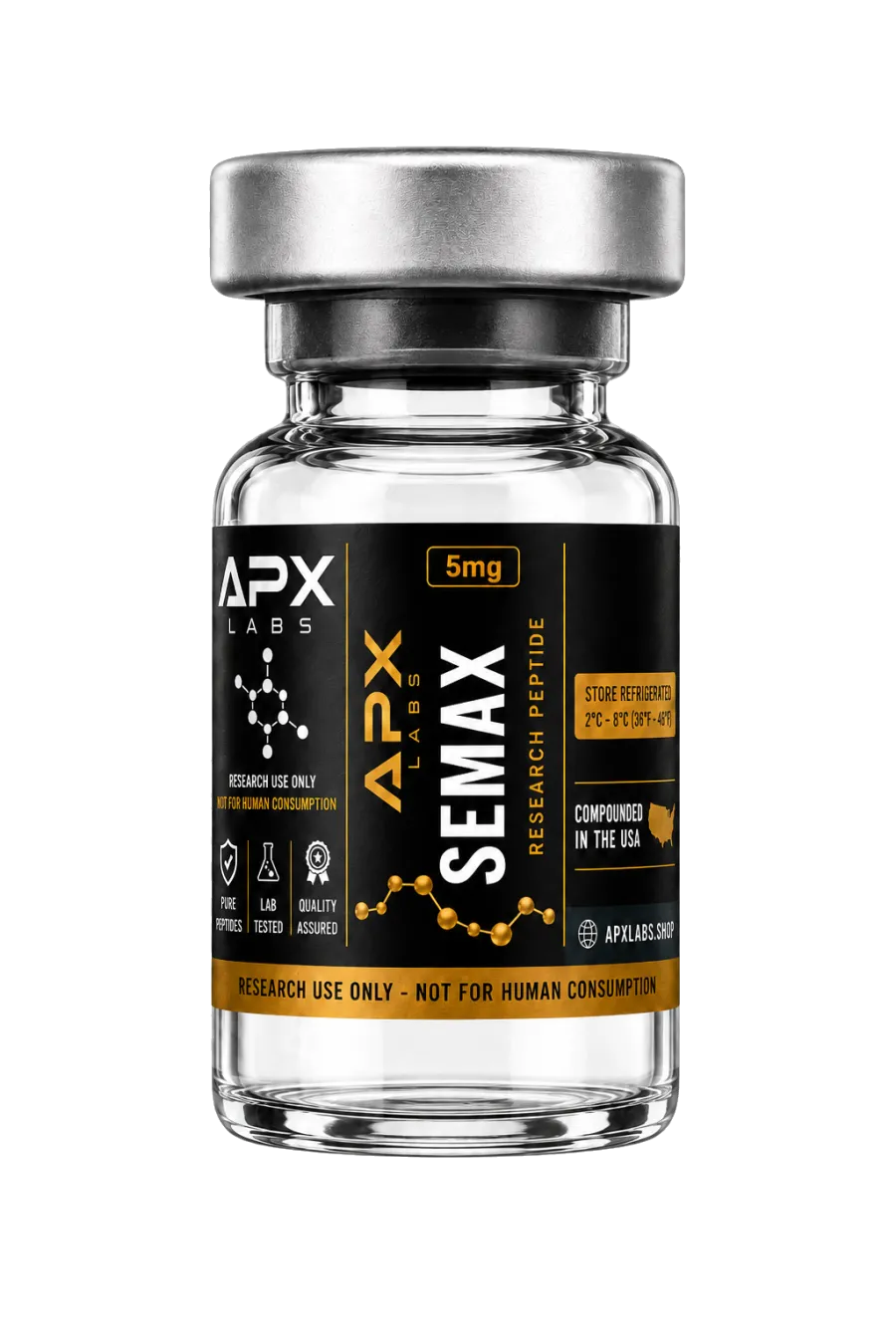
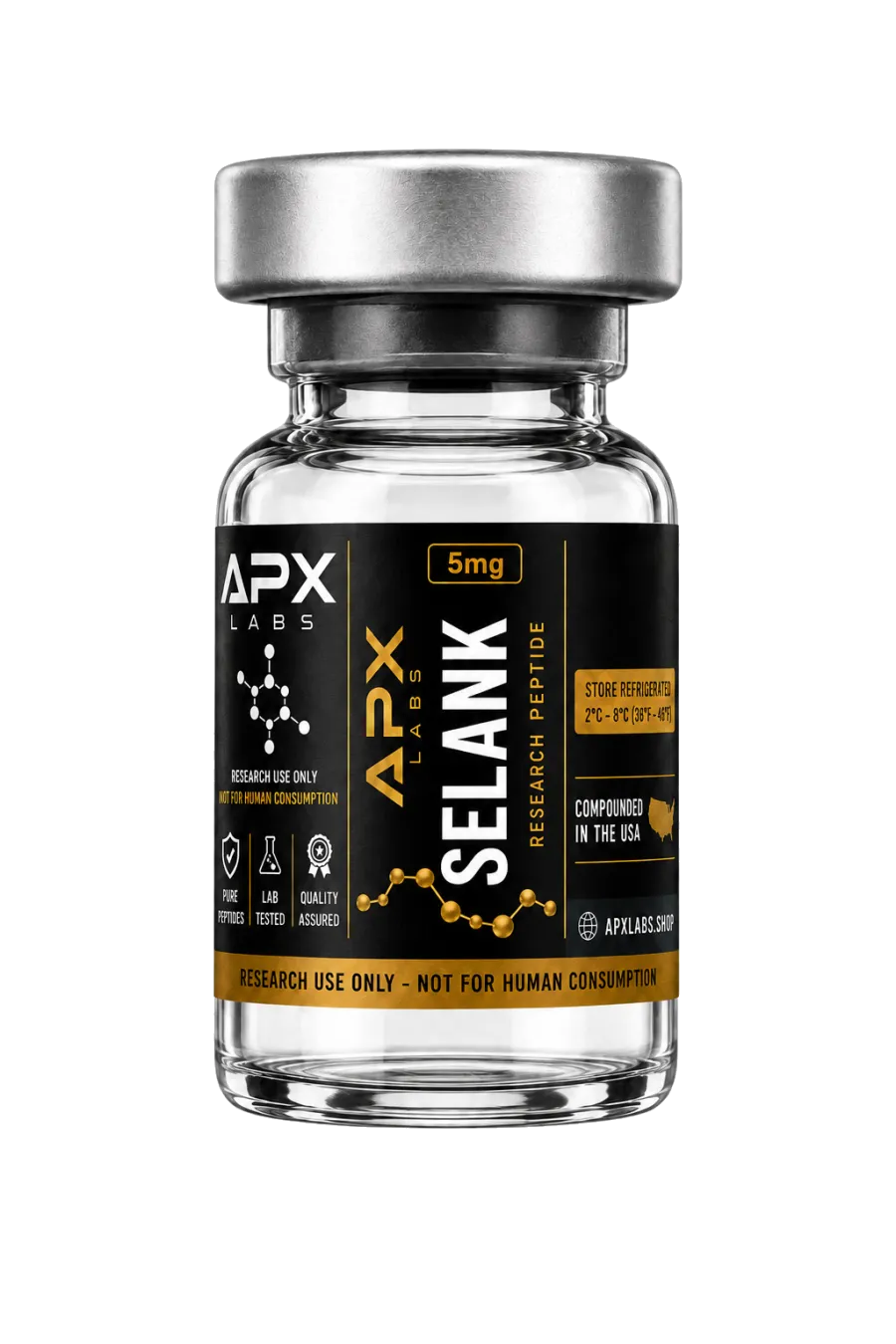
Semax (Met-Glu-His-Phe-Pro-Gly-Pro) derives from the ACTH(4-10) fragment and is studied for neurotrophin (BDNF) expression, stress and attention-related endpoints. Selank (Thr-Lys-Pro-Arg-Pro-Gly-Pro) derives from the immunopeptide tuftsin and is studied for anxiolytic-type behaviour and stress adaptation. Both were developed at the Institute of Molecular Genetics in Moscow and both carry a Pro-Gly-Pro tail for enzymatic stability.
Shared design, different parents
Both peptides come from the same Moscow research lineage and use the same trick: take a short biologically active fragment and add Pro-Gly-Pro at the C-terminus to slow enzymatic breakdown. That is where the similarity ends.
Semax starts from ACTH(4-10) — residues 4 to 10 of adrenocorticotropic hormone, a fragment long known to have central-nervous-system activity without ACTH's hormonal effect. Its sequence is Met-Glu-His-Phe-Pro-Gly-Pro (813.9 g/mol).
Selank starts from tuftsin — Thr-Lys-Pro-Arg, a tetrapeptide fragment of immunoglobulin G with immune-signalling activity. Its sequence is Thr-Lys-Pro-Arg-Pro-Gly-Pro (751.9 g/mol).
Mechanisms studied
Semax research centres on neurotrophins. A 2007 *Neuroscience Letters* study reported altered BDNF and related gene expression in rat brain [1]; later work compared nootropic agents' effects on hippocampal and cortical BDNF [2], examined antidepressant-like and antistress effects alongside other ACTH(4-10) analogs [3], and looked at intracellular calcium dynamics [4].
Selank research centres on anxiolytic-type behaviour. A 2018 review collects the molecular work [5]; foundational studies placed it among tuftsin-family peptides regulating adaptive behaviour under stress [6]; and a 2014 rat study examined it in a modelled withdrawal setting [7].
Research models compared
- Neurotrophin / gene expression: Semax [1][2]
- Anxiolytic-type behavioural assays: Selank [5][6]
- Stress models: both, from different angles — Semax for antistress and early-life-stress endpoints [3], Selank for stress adaptation [6]
- Withdrawal models: Selank [7]
Specifications side by side
- Parent: ACTH(4-10) · tuftsin
- Sequence: MEHFPGP · TKPRPGP
- Molecular weight: 813.9 g/mol · 751.9 g/mol
- Format: Semax 30 mg vial, $55 · Selank 10 mg vial, $50
- Testing: independent HPLC/MS, batch COA, both
Rodent and cell research only. Neither compound is approved by the FDA; APX Labs products are for research use only and nothing here is a claim of effect.
Frequently asked
Are Semax and Selank related?⌄
Which is studied for BDNF?⌄
Why do both end in Pro-Gly-Pro?⌄
References
Published research cited for context only. Citing a study does not imply APX Labs product was used in it, and is not a claim of any effect.
- Dolotov OV, et al. (2007). Neurotrophin gene expression in rat brain under the action of Semax, an analogue of ACTH 4-10. Neurosci Lett. PubMed ↗
- Voronina TA, et al. (2009). Effects of nootropic drugs on hippocampal and cortical BDNF levels in mice with different exploratory behavior. Eksp Klin Farmakol. PubMed ↗
- Manchenko DM, et al. (2024). Antidepressant-like and antistress effects of the ACTH(4-10) synthetic analogs Semax and Melanotan II. Eur J Pharmacol. PubMed ↗
- Kolbaev SN, Sharonova IN, Skrebitsky VG (2025). The Effect of Peptide Semax, an ACTH(4-10) Analogue, on Intracellular Calcium Dynamics in Rat Brain. Bull Exp Biol Med. PubMed ↗
- Vyunova TV, et al. (2018). Peptide-based Anxiolytics: The Molecular Aspects of Heptapeptide Selank Biological Activity. Protein Pept Lett. PubMed ↗
- Kozlovskaya MM, Kozlovskii II, Val'dman EA (2003). Selank and short peptides of the tuftsin family in the regulation of adaptive behavior in stress. Neurosci Behav Physiol. PubMed ↗
- Kolik LG, Nadorova AV, Kozlovskaya MM (2014). Efficacy of peptide anxiolytic selank during modeling of withdrawal syndrome in rats. Bull Exp Biol Med. PubMed ↗
Compounds mentioned
Keep reading
- How to Reconstitute Lyophilized Peptides for Laboratory UseLyophilized peptides arrive as a dry cake in a sealed vial. Turning that into a solution of known concentration is simple, but the details protect the material.
Ready to start your research?
Third-party tested. COA-backed. Shipped discreetly. For research use only.