
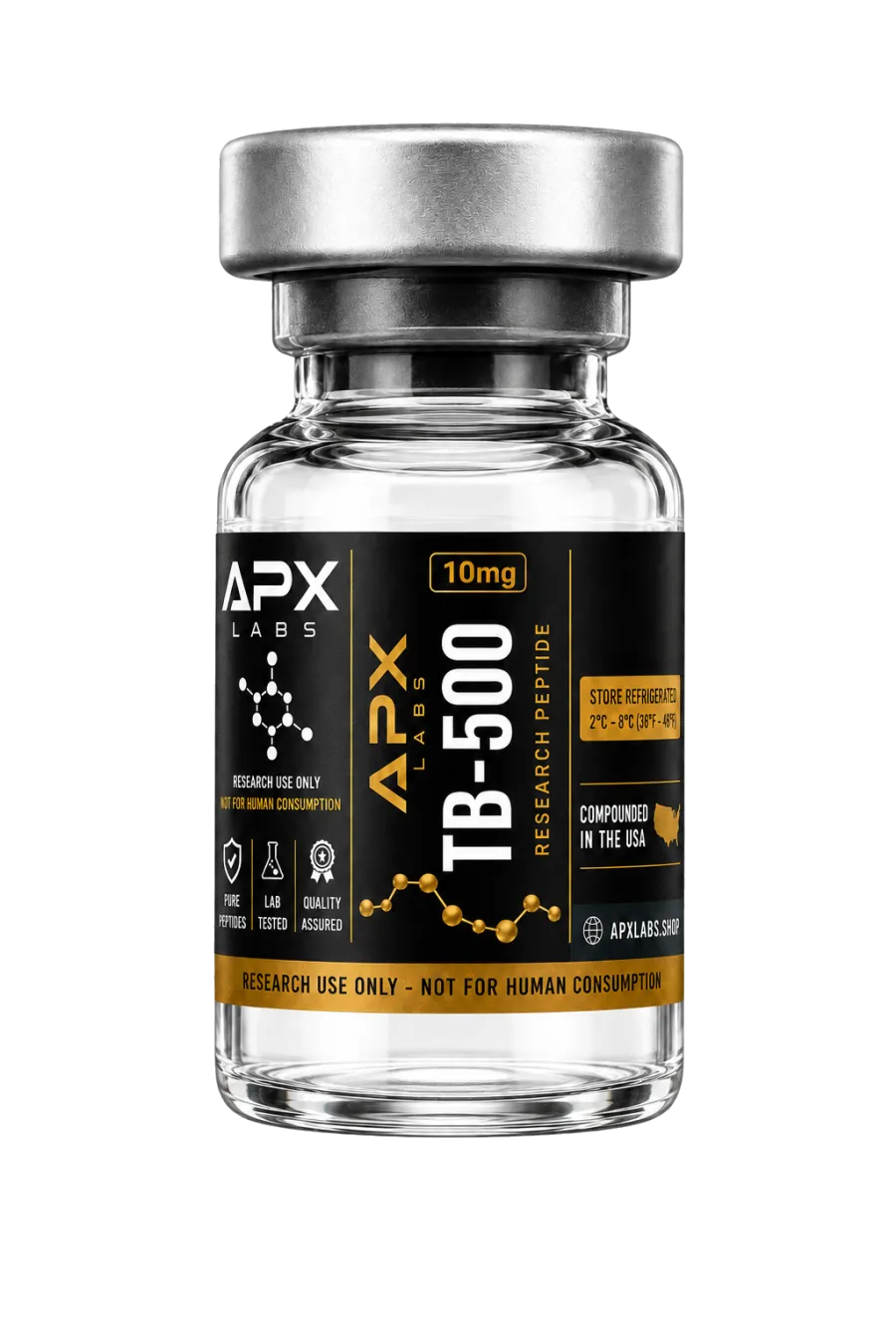
TB-500
TB-500 is a synthetic peptide fragment of thymosin β4 (Tβ4), a 43-amino-acid actin-binding protein found in nearly all mammalian cells. The fragment (Ac-LKKTETQ) contains the actin-binding domain and is studied in cell-migration, angiogenesis and tissue-repair models. APX Labs supplies it as a 10 mg lyophilized vial, ≥99% purity by HPLC/MS, with a batch-specific COA. Research use only.
- Class: synthetic thymosin β4 fragment, actin-binding domain
- Sequence: Ac-Leu-Lys-Lys-Thr-Glu-Thr-Gln (Ac-LKKTETQ)
- Research contexts in the literature: actin sequestration, cell migration, angiogenesis, cardiac and dermal repair models
- Format: 10 mg lyophilized vial — reconstitute with bacteriostatic water
- Documentation: independent HPLC/MS test, batch-specific COA in every order
- Research category
- Recovery & Repair
- Amino-acid sequence
- Ac-Leu-Lys-Lys-Thr-Glu-Thr-Gln
- Formula / short form
- Ac-LKKTETQ
- Molecular weight
- 4963.4 g/mol
- Quantity per vial
- 10 mg
- Purity
- ≥99% (HPLC/MS, per-lot COA)
- Test method
- HPLC / MS
- Form
- Lyophilized powder
- Documentation
- Batch-specific COA ships with every order
What is TB-500?
Thymosin β4 is a small, highly conserved protein whose best-characterised job is sequestering G-actin — it regulates how cells build and dismantle their cytoskeleton, and therefore how they move. TB-500 is the synthetic seven-residue fragment that carries the actin-binding motif (LKKTETQ), acetylated at the N-terminus for stability. Much of the literature refers to the parent protein, thymosin β4; the fragment is used in research as a smaller, more tractable stand-in for that active site [1].
What is TB-500 studied for in research?
- Actin regulation and cell migration. The parent protein's actin-sequestering role is the mechanistic foundation for most of its study [2]; short-sequence work has mapped which residues account for which activity [3].
- Cardiac repair models. Thymosin β4 has been investigated in animal models of cardiac injury and repair [4].
- Inflammation and regeneration. Reviews collect work on autophagy-linked anti-inflammatory activity and broader regenerative research directions [5].
These describe laboratory research on thymosin β4 and its fragments. They are not claims about effects in humans.
TB-500 vs BPC-157
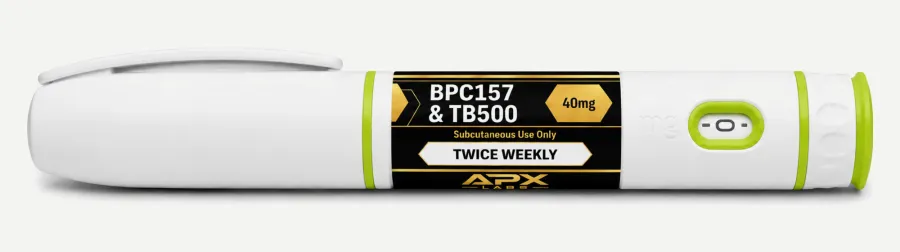
TB-500 and BPC-157 are the two most-requested compounds in the recovery category and are frequently evaluated together, but they are structurally and mechanistically distinct. Full comparison: BPC-157 vs TB-500. Also available pre-blended: BPC-157 & TB-500 research pen.
Specifications, purity and documentation
Identity is confirmed by mass spectrometry against the expected fragment mass; purity by HPLC. Note that literature molecular weights often refer to the full 43-residue thymosin β4 (~4,963 g/mol) rather than the fragment — the COA states the mass actually measured for the lot you receive. How to read the COA →
TB-500 — frequently asked
What is TB-500?⌄
Is TB-500 the same as thymosin beta-4?⌄
How is TB-500 purity verified?⌄
How should TB-500 be stored?⌄
Further reading
- BPC-157 vs TB-500: What the Research Actually Compares — The two most-requested recovery-category peptides are structurally unrelated and studied through different pathways. Here is the side-by-side, with sources.
- How to Read a Peptide Certificate of Analysis (COA) — Every APX Labs order ships with a batch-specific COA. This is how to read it — and how to tell a real one from a decorative one.
- How to Reconstitute Lyophilized Peptides for Laboratory Use — Lyophilized peptides arrive as a dry cake in a sealed vial. Turning that into a solution of known concentration is simple, but the details protect the material.
- What HPLC/MS Purity Testing Actually Measures — Two techniques, two questions. HPLC asks how much; mass spectrometry asks what. A COA that answers only one is half a COA.
References
Published research cited for context only. Citing a study does not imply APX Labs product was used in it, and is not a claim of any effect.
- Goldstein AL, Hannappel E, Kleinman HK (2005). Thymosin beta4: actin-sequestering protein moonlights to repair injured tissues. Trends Mol Med. PubMed ↗
- Goldstein AL, Kleinman HK (2015). Advances in the basic and clinical applications of thymosin β4. Expert Opin Biol Ther. PubMed ↗
- Sosne G, et al. (2010). Biological activities of thymosin beta4 defined by active sites in short peptide sequences. FASEB J. PubMed ↗
- Bock-Marquette I, et al. (2010). Thymosin beta4 and cardiac repair. Ann N Y Acad Sci. PubMed ↗
- Renga G, et al. (2018). Thymosin β4 limits inflammation through autophagy. Expert Opin Biol Ther. PubMed ↗
What is TB-500 studied for?
Investigated in tissue-repair and cell-migration research for its studied role in actin regulation, angiogenesis, and recovery across muscle and connective-tissue models.
Reconstitution & storage
Ships lyophilized in a sealed vial. Store cold and away from light. Reconstitute with bacteriostatic water (not included); once reconstituted, keep refrigerated and use within the window documented on the COA.
Research use only
Sold strictly for laboratory and research purposes. Not for human or veterinary use, and not intended to diagnose, treat, cure, or prevent any disease. Not evaluated by the FDA. Read the policy → · What RUO means →
Ready to start your research?
Third-party tested. COA-backed. Shipped discreetly. For research use only.