
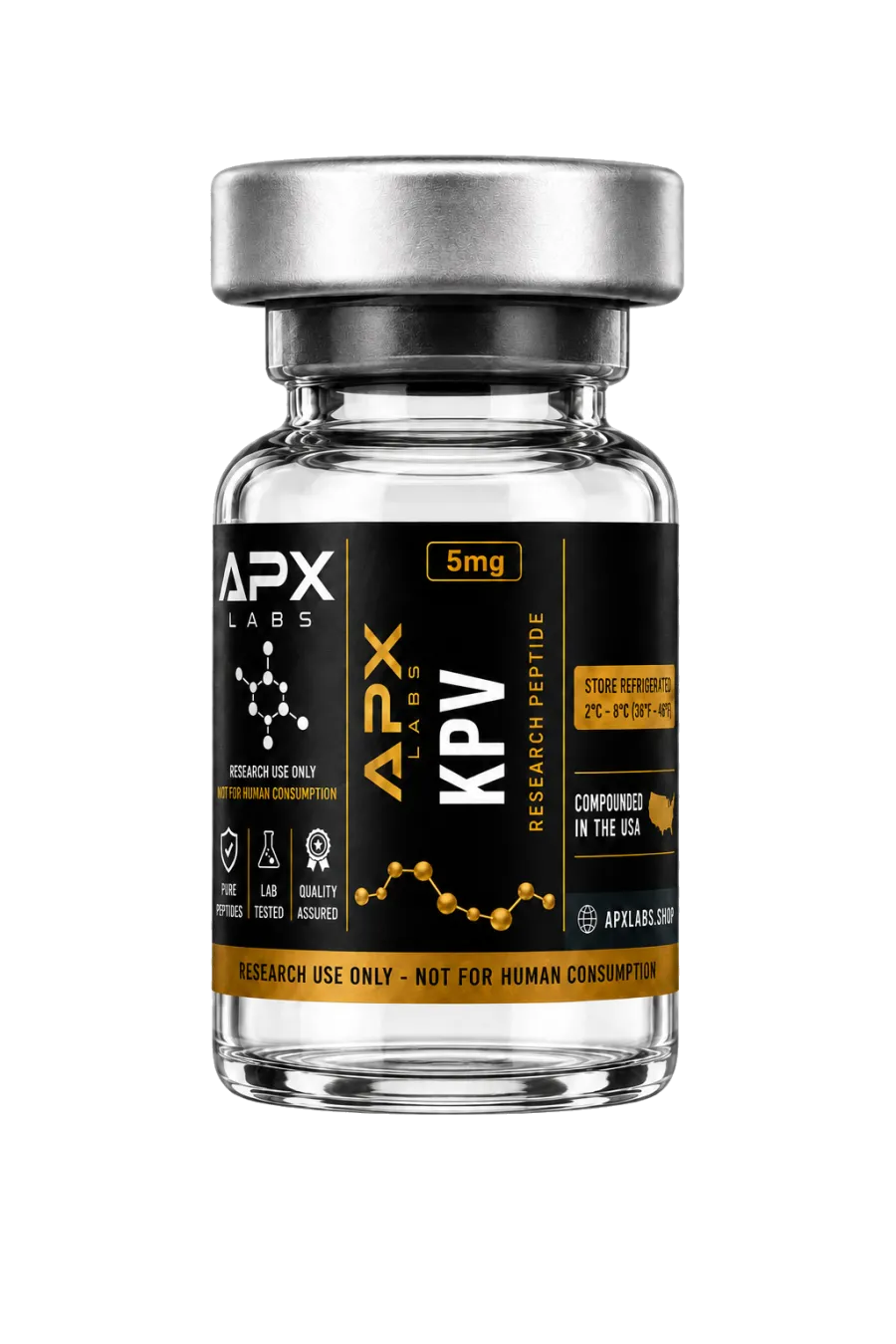
KPV
KPV is a tripeptide — lysine-proline-valine, 342.4 g/mol — that forms the C-terminal end of α-melanocyte-stimulating hormone (α-MSH). In research it is studied as a minimal melanocortin fragment in models of intestinal inflammation and cutaneous repair. APX Labs supplies it as a 10 mg lyophilized vial, ≥99% purity by HPLC/MS, with a batch-specific COA. Research use only.
- Class: α-MSH C-terminal tripeptide (melanocortin fragment)
- Sequence: Lys-Pro-Val
- Research contexts in the literature: intestinal inflammation models, PepT1 transport, melanocortin signalling, wound-model reviews
- Format: 10 mg lyophilized vial — reconstitute with bacteriostatic water
- Documentation: independent HPLC/MS test, batch-specific COA in every order
- Research category
- Recovery & Repair
- Amino-acid sequence
- Lys-Pro-Val
- Formula / short form
- Lys-Pro-Val
- Molecular weight
- 342.4 g/mol
- Quantity per vial
- 10 mg
- Purity
- ≥99% (HPLC/MS, per-lot COA)
- Test method
- HPLC / MS
- Form
- Lyophilized powder
- Documentation
- Batch-specific COA ships with every order
What is KPV?
α-MSH is a 13-amino-acid melanocortin hormone. Its last three residues, Lys-Pro-Val, have been studied on their own because they appear to carry much of the parent peptide's anti-inflammatory activity in laboratory models while being far smaller and simpler to synthesise. KPV is therefore one of the smallest peptides in the APX Labs catalog.
What is KPV studied for in research?
- Intestinal inflammation models. A well-cited Gastroenterology paper reported that KPV is taken up by the intestinal transporter PepT1 and reduced inflammation in mouse colitis models [1]; follow-up work delivered KPV via colon-targeted nanoparticles [2] and hydrogels [3].
- Melanocortin receptor research. KPV and related melanocortin peptides are studied for anti-inflammatory and chondroprotective signalling [4] and reviewed as candidates in cutaneous wound-model research [5].
Laboratory findings only — not claims of human effect.
Specifications, purity and documentation
Identity by mass spectrometry (expected 342.4 g/mol), purity by HPLC, batch-specific COA in every order. How to read the COA →
KPV — frequently asked
What is KPV?⌄
How is KPV different from BPC-157?⌄
How should KPV be stored?⌄
Further reading
- How to Reconstitute Lyophilized Peptides for Laboratory Use — Lyophilized peptides arrive as a dry cake in a sealed vial. Turning that into a solution of known concentration is simple, but the details protect the material.
References
Published research cited for context only. Citing a study does not imply APX Labs product was used in it, and is not a claim of any effect.
- Dalmasso G, et al. (2008). PepT1-mediated tripeptide KPV uptake reduces intestinal inflammation. Gastroenterology. PubMed ↗
- Laroui H, et al. (2010). Drug-loaded nanoparticles targeted to the colon with polysaccharide hydrogel reduce colitis in a mouse model. Gastroenterology. PubMed ↗
- Xu Y, et al. (2021). Self-Cross-Linked Hydrogel of Cysteamine-Grafted γ-Polyglutamic Acid Stabilized Tripeptide KPV. ACS Biomater Sci Eng. PubMed ↗
- Kaneva MK, et al. (2020). Novel anti-inflammatory and chondroprotective effects of the human melanocortin MC1 receptor agonist. Eur J Pharmacol. PubMed ↗
- Böhm M, Grässel S (2019). Are melanocortin peptides future therapeutics for cutaneous wound healing?. Exp Dermatol. PubMed ↗
What is KPV studied for?
Referenced in inflammation and gut-repair research models for its studied anti-inflammatory signalling and tissue-calming properties.
Reconstitution & storage
Ships lyophilized in a sealed vial. Store cold and away from light. Reconstitute with bacteriostatic water (not included); once reconstituted, keep refrigerated and use within the window documented on the COA.
Research use only
Sold strictly for laboratory and research purposes. Not for human or veterinary use, and not intended to diagnose, treat, cure, or prevent any disease. Not evaluated by the FDA. Read the policy → · What RUO means →
Ready to start your research?
Third-party tested. COA-backed. Shipped discreetly. For research use only.