
Multi-Peptide Research Blends Explained
A blend is not a new molecule. It is two or more compounds held at a fixed ratio so a series can vary one thing at a time.
Published 2026-09-18 · APX Labs Research Desk · For laboratory research context only — not medical advice.
A research blend co-formulates two or more compounds in one pre-filled pen at a fixed ratio. It exists for series in which the compounds are always evaluated together and preparation variance is unwanted. Each component is tested and reported separately on the COA. Laboratories that need to vary the ratio should use separate vials.
What a blend is
A co-formulation: two or more compounds dissolved together in a single pre-filled research pen at a fixed ratio. Nothing is chemically joined; the components are the same molecules available individually. The blend is a format, chosen for consistency, not a distinct compound.
Why laboratories use them
When a series always evaluates the same compounds together, preparing each separately introduces variance — in concentration, in ratio, in timing — that has nothing to do with the question being studied. A pre-measured blend removes it. It also removes several reconstitution steps, which matters over a long series. The general case for the pen format is in vial vs pen.
When not to use them
When the ratio is itself a variable; when one component is needed alone; when long storage is required (pens must stay refrigerated and have a shorter life than lyophilized vials). In those cases, separate vials.
The APX Labs blends
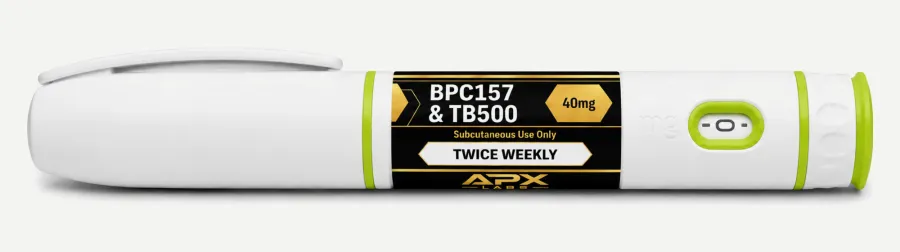
- BPC-157 & TB-500 — the two most-requested recovery-category peptides, a gastric-derived pentadecapeptide [1] and a thymosin β4 fragment [2], co-formulated for laboratories that evaluate them together. Compared in detail in BPC-157 vs TB-500.
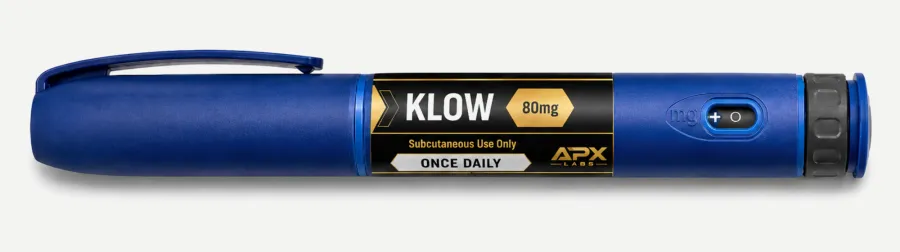
- KLOW — a multi-peptide regeneration blend; the full component list with per-component identity and purity is on the batch COA.
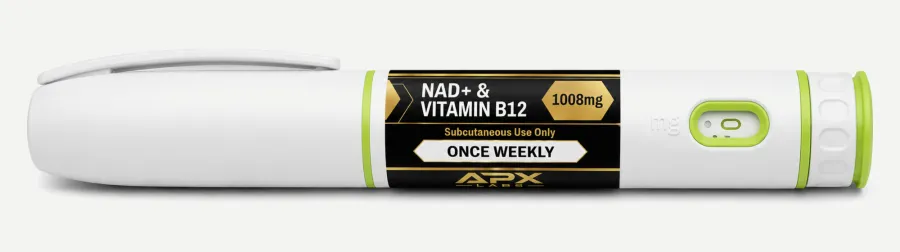
- NAD+ & Vitamin B12 — not peptides but a coenzyme and a vitamin, co-formulated for cellular-energy and methylation research [3].
Testing and documentation
Each component of a blend is tested by HPLC/MS and reported on its own line of the COA, so the documentation is as complete as for a single compound. See how we test and how to read a COA.
Format guidance for laboratory handling only. Nothing here is a claim about the effect of any compound or combination. APX Labs products are for research use only.
Frequently asked
Is a peptide blend a new compound?⌄
Can I get blend components separately?⌄
Why do blends only come as pens?⌄
References
Published research cited for context only. Citing a study does not imply APX Labs product was used in it, and is not a claim of any effect.
- Sikiric P, et al. (2025). Stable Gastric Pentadecapeptide BPC 157 as a Therapy and Safety Key. Pharmaceuticals (Basel). PubMed ↗
- Goldstein AL, Hannappel E, Kleinman HK (2005). Thymosin beta4: actin-sequestering protein moonlights to repair injured tissues. Trends Mol Med. PubMed ↗
- Yoshino J, Baur JA, Imai SI (2018). NAD+ Intermediates: The Biology and Therapeutic Potential of NMN and NR. Cell Metab. PubMed ↗
Compounds mentioned
Keep reading
- BPC-157 vs TB-500: What the Research Actually ComparesThe two most-requested recovery-category peptides are structurally unrelated and studied through different pathways. Here is the side-by-side, with sources.
- How to Store Research Peptides: Lyophilized, Reconstituted and Pre-FilledPeptides degrade by hydrolysis, oxidation and aggregation. Cold, dark and dry slow all three. The practical rules, by format.
- Lyophilized Vial vs Pre-Filled Pen: Choosing a Research FormatNine catalog compounds ship as vials, five as pens. The choice is about flexibility versus consistency, not quality.
Ready to start your research?
Third-party tested. COA-backed. Shipped discreetly. For research use only.